
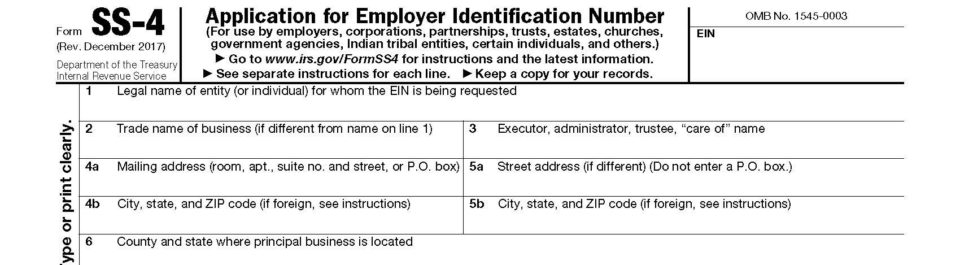
The IRS recently updated (revised December 2017) its form SS-4 “Application for Employer Identification Number” (EIN). You’ll want to be aware of this change if you are the person completing the EIN application for a new or existing corporation, limited liability company, trust, or other entity that is required to get a federal EIN.
Lines 7a and 7b on form SS-4 have been changed.
Previously, line 7a requested the “Name of Responsible Party” to be provided when applying for the EIN. Instructions published for form SS-4 (revised January 2011), for instance, identified the responsible party to be “[T]he full name (first name, middle initial, last name,if applicable) and SSN, ITIN (individual taxpayer identification number), or EIN of the entity’s responsible party as defined below.” (Emphasis added.)
A “responsible party” is someone who “…controls, manages, poor directs the applicant entity and the disposition of its funds and assets.” That party is also responsible to the IRS in the event of any future dealings between that agency and the company that is applying for the EIN.
The IRS has required an applicant on form SS-4 lines 7a and 7b to disclose the name and federal EIN or Social Security Number (SSN) of the “responsible party” since 2010. IRS requires a business entity, estate, and certain trusts to have a distinct EIN for making federal tax filings (tax returns, employee withholdings payments, estimated tax payments, tax status elections, etc.).
It is not unusual for another entity to fill the position of a general partner for a partnership, or a manager or member of an LLC, or a trustee or beneficiary of a trust. In the past, in such cases, the responsible “party,” then, might actually have been another business organization.
For example, a corporation, limited liability company, limited partnership, or another form of business organization might be the general partner of a limited or general partnership; or the trustee or beneficiary of a trust; or a member or a manager of an LLC; and so forth thereby constituting the “responsible party” for that new entity that is applying for a new EIN.

[Sidebar: In the US, an entity generally cannot be a director or officer of a corporation, i.e. Ajax Management Inc. cannot be a director or officer of Acme Corporation. Only “natural persons” (human people) may serve in those positions. For example, see the Delaware Corporations Code, 8 Del. C. § 141(b).]
Now, however, line 7a of the revised form SS-4 requires the “Name of Responsible Person” (not the responsible “party“). The IRS now indicates this to mean a responsible “party” must be an individual flesh-and-blood human being (the responsible “person”). There appears to be no wiggle room to isolate a human director or officer or other authorized company designee to act with limited personal liability when applying for the EIN. One physical human person must be on the hook for the entity’s federal tax matters.
Under the newly updated instructions, for entities and businesses, the responsible person will be a principal company officer, such as the chief executive officer, president or treasurer of a corporation; or the manager or managing member(s) of an LLC; the primary officer of a corporation or company that is the general partner in a partnership; and so on. In other words, the responsible person designated on lines 7a and b applying for the EIN will be a living breathing human person who has effective control over the entity, and one who is responsible for the management and overall operation of that company.
Think: Tax Matters Partner (or TMP: that individual person responsible for tax matters that pertain to a partnership or LLC).
Any person listed as the responsible party or person who does not, in fact, hold this position of management and operational authority over the applicant entity is risking a serious personal challenge from the IRS over the SS-4 information they provide on the form.
It appears there were no other substantial changes to form SS-4 in its December 2017 iteration.
As with all tax forms and matters, you should consult with a competent licensed professional tax advisor if you have any questions completing form SS-4. Compliance is crucial, and you want to get this right the first time. You don’t want to find yourself mistakenly on the wrong end of an IRS inquiry over this matter.